Interpreting Black Box Data: The Digital Witness in Trucking Accidents
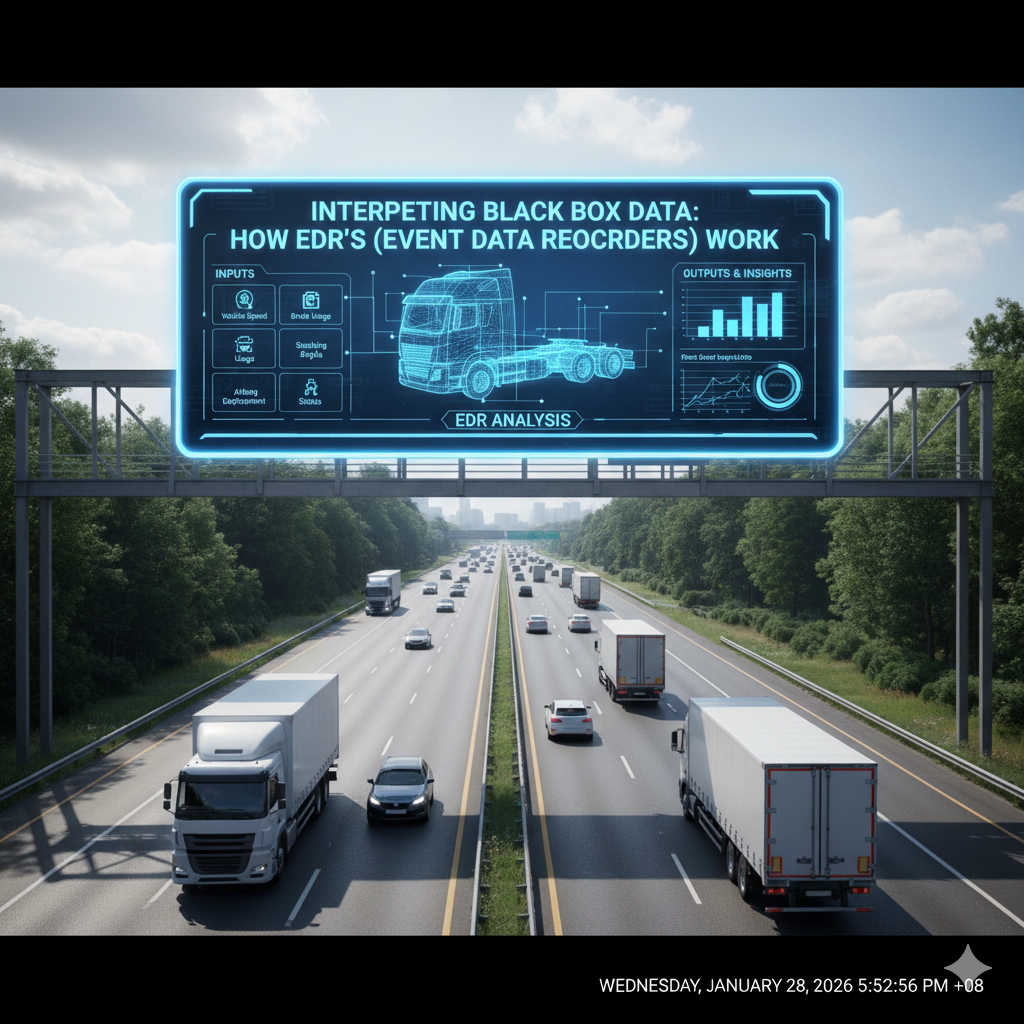
What data does a truck’s black box record? A truck’s Event Data Recorder (EDR) captures a snapshot of mechanical data triggered by a “critical event,” such as a collision or sudden deceleration. As of 2026, many modern EDRs have been updated to record up to 20 seconds of pre-crash data (up from 5 seconds in older models). This includes vehicle speed, brake application, engine throttle, steering wheel angle, and seatbelt status. This objective data is used by forensic experts to prove driver negligence or mechanical failure.
How an EDR “Decides” to Record
Unlike a dashcam that may record continuously, an EDR is a “loop” recorder. It only saves data to its permanent memory when it senses a Trigger Event:
-
Deployment Events: Airbag deployment or seatbelt pretensioner activation. These files are usually “locked” and cannot be overwritten.
-
Non-Deployment Events: A sudden change in velocity (Delta-V) or a “hard braking” event that doesn’t trigger airbags.
-
2026 Update: Newer systems are more sensitive to “near-miss” events, helping lawyers prove a pattern of reckless driving even before the final crash.
performance, and the general driving experience. The Event Data Recorder (EDR), commonly known as a black box to cars, is one of the most significant technology advances in the automobile industry. Similar to the black boxes in aircrafts, the devices record important data in case of car accidents and crashes. This information has played a critical role in rebuilding accidents, enhancing the level of safety of vehicles, and bringing justice in court cases. However, what are the working principles of EDRs, and what is the interpretation of the black box data?
Throughout this blog, we will have a closer look at how EDRs work, the nature of data gathered by them and how this important information is interpreted.
What is an Event Data Recorder (EDR)?
An Event Data Recorder (EDR) is a device fitted on the majority of the modern vehicles to gather and store data during an accident or other major occurrences such as hard braking, airbag deployment, or high-speed deceleration. It works like a black box in an aircraft, where certain data points are recorded, and they are essential in knowing the events before an accident.
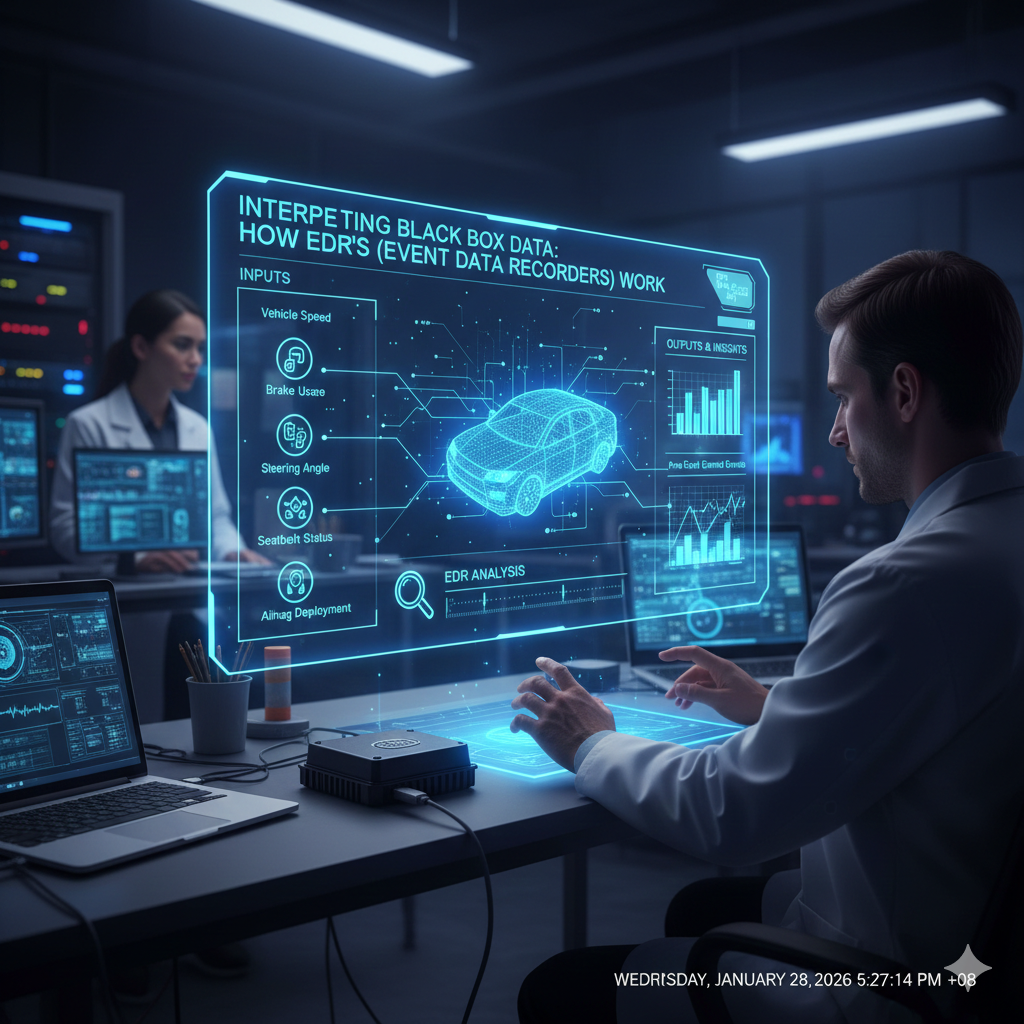
According to the National Highway Traffic Safety Administration (NHTSA), EDRs refer to a gadget mounted in a vehicle to capture the functioning of a vehicle safety system in the event of an accident. EDRs are programmed to trap a wide range of metrics, including:
- Vehicle speed
- Seatbelt usage
- Braking force
- Airbag deployment
- Impact force
The information is indispensable to the accident investigation team, insurance firms, and even lawyers in their quest to establish the cause of an accident.
How EDRs Capture Data
The EDRs operate on the principle of constant recording of certain vehicle parameters and storing the information in non-volatile memory. This implies that in the event of power outage or the crash of the computer, the information is still there and can be accessed. EDRs start operating under major events, like a collision and start capturing data, including the speed of the vehicle, throttle position, braking force, steering angle, and other important data.
There are also highly-developed EDRs that record the exact time when airbags were deployed, activated, and the seatbelt position of the passengers and the driver. Such information assists in recreating the chronology of events that took place in the crash.
Black box Data Role in Accident Investigation
The information that an EDR gathers is crucial in re-creating an accident. The black box data is retrieved in the aftermath of a crash to give the investigators the exact situation leading to the collision. The information assists in answering such significant questions:
- Was the driver speeding?
- Was the driver able to use the brakes in time?
- Were the airbags deployed?
- Did the vehicle safety systems have any problems?
This data is usually used by law enforcement agencies, insurance companies, and crash investigators to establish the cause of an accident. Indicatively, when a driver says that he braked prior to a collision but an EDR data indicates that the braking mechanisms were not activated, the black box data may indicate the presence of important discrepancies and explain the case.
What Data Do EDRs Record?
Though the details may differ depending on the vehicle, the majority of EDRs capture the following types of data:
- Vehicle Speed: This is one of the most significant pieces of data. It gives an idea of the speed of the vehicle when the crash occurred.
- Throttle Position: Throttle position shows the degree of acceleration that the car was experiencing. This piece of information is crucial in case the car was accelerating fast prior to the accident.
- Braking Force: This information will show whether the driver tried to decelerate or decrease the speed at the time of the incident. The aggressiveness of braking may indicate how fast the driver responded to the situation.
- Seatbelt Status: This information indicates whether the driver and the passengers were wearing seatbelts during the crash. The use of seatbelts is also a significant issue when it comes to the level of injuries.
- Airbag Deployment: EDRs capture the deployment of the airbags. This is possible to enable investigators to know how serious the collision was and whether the airbags deployed as anticipated.
- Steering Angle: This is used to tell whether the driver was trying to avoid the crash or the vehicle was not controlled.
- Impact Force: There are some advanced EDRs that measure the force of the impact and this assists in determining the extent of the crash.
Retrieving Black Box Data
The EDR data may be accessed after an accident with the help of a special device that is attached to the diagnostic port of a car. The information is normally recorded in a format that can be read and analyzed using crash reconstruction software that can be used to give detailed reports of how the vehicle acted during the crash.
It should be mentioned that the black box data access demands appropriate legal procedures. In the USA, the law enforcement, insurance companies or legal professionals engaged in a lawsuit can subpoena this data. In other cases, however, the consent of the driver might be required, according to the privacy laws of the state.
Interpreting Black Box Data: The Process
The analysis of black box data often known as Event Data Recorder (EDR) analysis is a methodical examination of the documented car measurements to reveal precisely what transpired prior to, on, and instantly subsequent to an accident. This process is common when serious injuries are involved, wrongful death cases, and contentious insurance investigations because of objectivity of the data.
Extraction of Data on the Event Data Recorder (EDR)
The initial one is data extraction that needs specialized diagnostic tools of vehicle manufacturers approval. The technicians access the data directly on the EDR, usually via the onboard diagnostic (OBD-II) port of the vehicle. The EDR module should be physically removed and handled in a controlled environment on certain occasions; particularly when the vehicle is heavily damaged. The extractions can be done at the crash site, tow yard or a certified forensic laboratory in order to maintain the integrity of the evidence.
Data Checking and Technical Review
After retrieval, data is then subjected to a validation procedure to ensure that it is accurate and complete. The main measures considered by the analysts are pre-crash speed, throttle position, brake application, seatbelt usage, timing of airbag deployment, and steering input. This will check whether the data is not corrupted and consistent with the known parameters of the vehicle and its manufactures.
Timeline Analysis and Crash Reconstruction
The black box data is then combined with the physical evidence such as skid marks, vehicle deformation, road conditions and traffic camera video by crash reconstruction specialists. Based on this mixed evidence, specialists reconstruct a second by second crash history. The analysis can be used to establish key elements like over speeding, slow braking, aggressive driving or even possible distraction of the driver prior to the accident.
Legal and Insurance Implementation of the Black Box Results
Once the technical analysis is made, the data that has been interpreted is applied in court cases and insurance reviews. Black box data may support or dispute eyewitnesses in a personal injury case or wrongful death claim. This information is used by insurance firms to determine the liability, coverage of policies and the value of claims. Where there are disputes, the information of EDR is usually presented in the role of strong evidence to prove fault, carelessness, or the violation of traffic regulations.
What Are the Significance of EDRs to Vehicle Safety?
EDRs are important in automobile safety and development. When manufacturers capture the data on the performance of vehicles during crashes, they are able to determine the possible areas that can be improved in terms of vehicle design and safety characteristics. Indicatively, when information indicates that a given model of vehicle is prone to breakdown at a specific speed or conditions, the information can be used to make alterations in the design of the subsequent models.
Furthermore, black box information can be useful in informing the population on safety. It also plays a role in research and development of improved crash safety standards and this has seen improvement in the airbag technology, seatbelt systems and vehicle crashworthiness.
Conclusion
The black box, the Event Data Recorder (EDR), is an important element of technology in the contemporary car. It offers good information on the steps that preceded an accident, so that the investigators of an accident, the insurance companies, and the lawyers acting in a case can have a clue about the situation of a particular incident. Having the information presented by the EDR, the authorities would be able to make better decisions regarding the causes of accidents and the liability, and in the end make the vehicles safer and minimize the accidents in the future.
With the further evolution of technologies, it is possible to anticipate more sophisticated functions in EDRs, which will enable us to acquire even more specific and detailed data on accidents. Learning more about the functioning of these systems does not only enable consumers to be informed but also allows them to make safer decisions behind the wheel.
-
Also read This “Coercion Rules“ post. (e.g., “EDR data often reveals the fatigue that leads to coercion; if a driver never touched the brakes, they were likely asleep.”)
-
For more information Read This Federal Register: Event Data Recorders.
FAQs
What is an Event Data Recorder (EDR)?
An Event Data Recorder (EDR), also commonly known as a black box in a vehicle, is a piece of equipment that is fitted in modern automobiles to record important data in case of an accident. It captures information regarding speed, braking force, the use of seatbelts, and the deployment of airbags to assist in reconstructing the events that preceded an accident.
What is an Event Data Recorder (EDR)?
EDRs constantly read and log important vehicle variables such as speed, throttle position and the intensity of braking. Upon the occurrence of a major event, e.g. crash, hard braking, etc., the EDR records this information in its memory. This information can then be accessed and processed in order to know the chronology of a crash.
What kind of data are Event Data Recorders (EDRs) able to capture?
Some of the types of data that are captured by EDRs are the speed of the vehicle, the presence of seatbelts, the deployment of airbags, the amount of braking force, throttle position, and steering angle. The information assists investigators of accidents and insurance firms in determining how the car was driven prior to, at the time and after the accident.
Why is EDR data significant to accident investigation?
The EDR information is very important in the investigation of accidents as it offers precise and objective information on how the vehicle behaved during an accident. It is capable of assisting in noting how fast the vehicle was moving, whether the driver used the brakes in good time and whether the airbags deployed in the proper manner which will help in providing fault.
Is it possible to use EDR data in courts?
Yes, EDR data can be utilized as legal evidence to aid in establishing liability and blame in accidents. The police, insurance agencies, and lawyers can request EDR data in order to determine how a car accident happened and whether some safety elements, such as airbags or seatbelts, were working correctly during the event.
Note: The content published on this blog is intended solely for informational and guidance purposes. We do not offer, promote, or provide any services through this website.