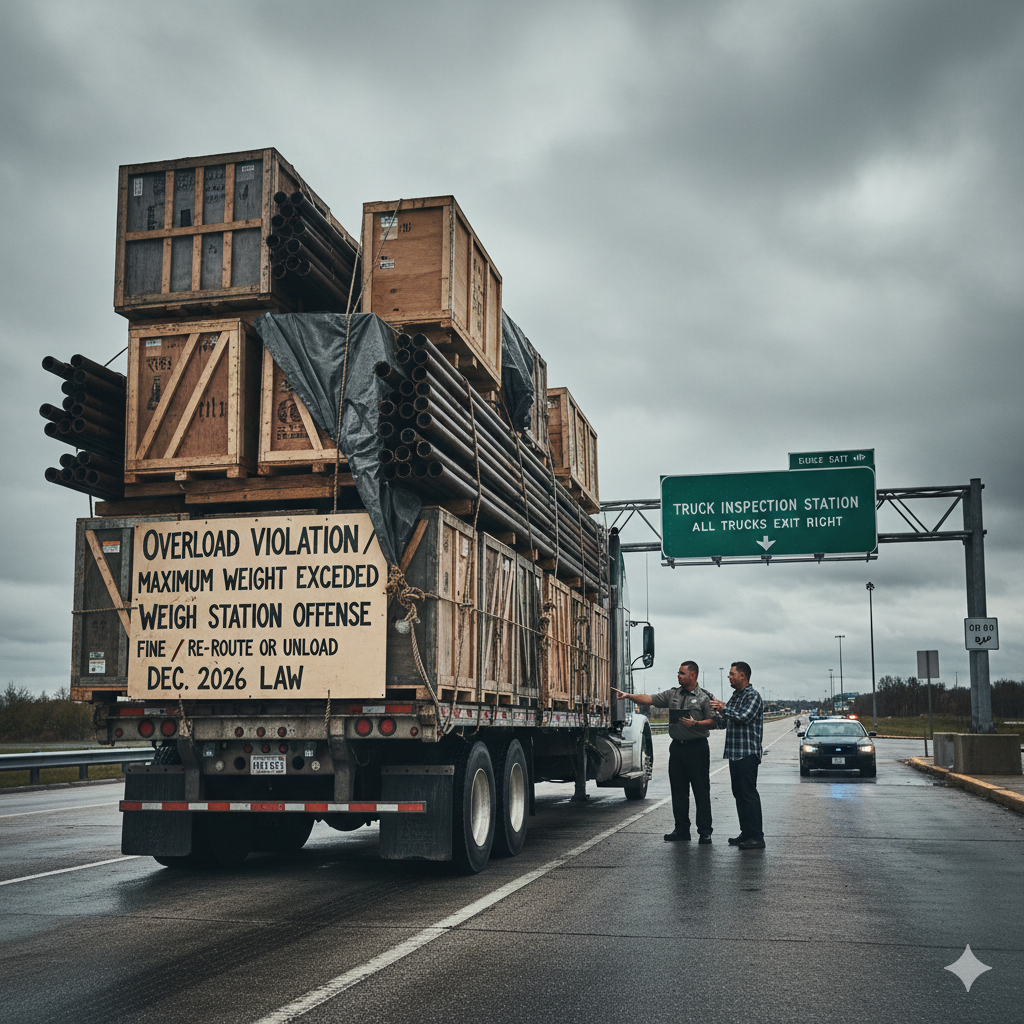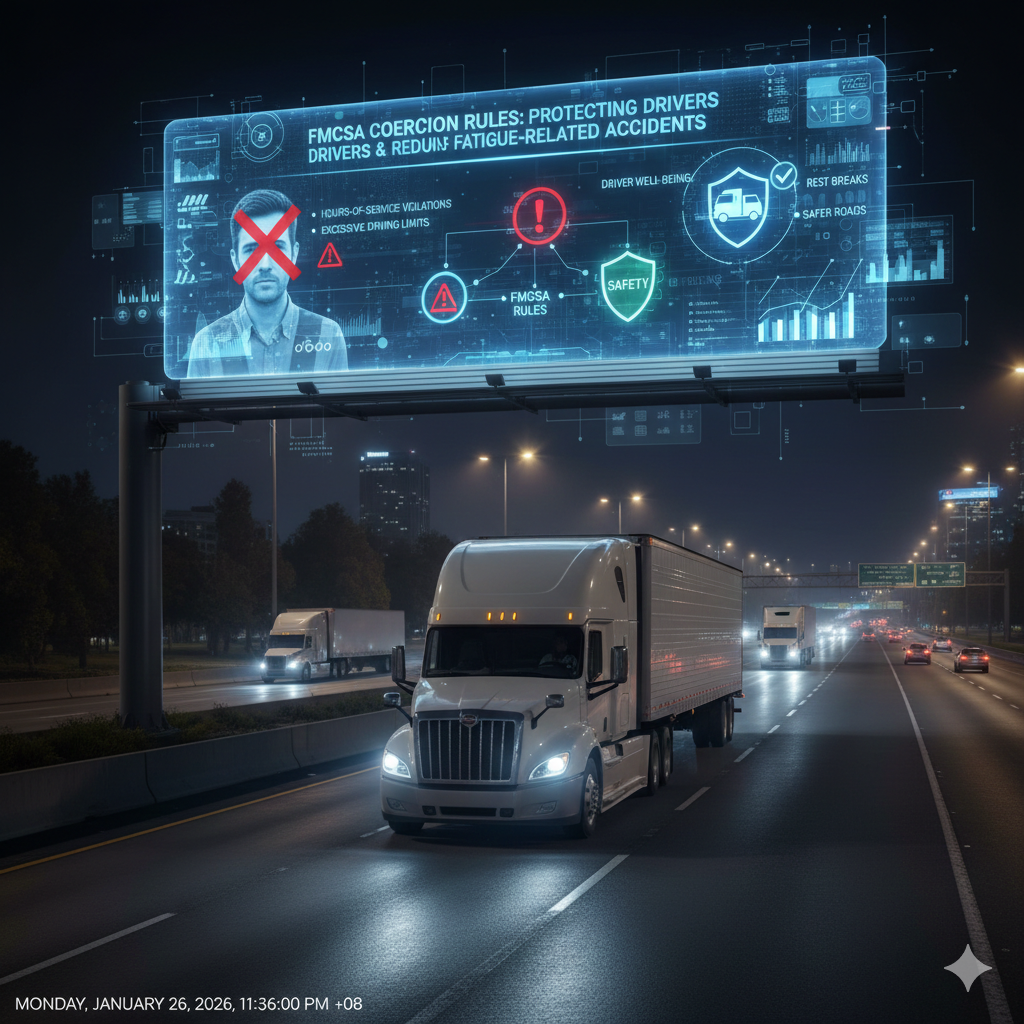
Coercion Rules: Protecting Drivers from Forced Dispatch and Fatigue
Can a trucking carrier legally force a tired driver to work? No. Under the FMCSA Anti-Coercion Rule (49 CFR 390.6), it is strictly illegal for a motor carrier, shipper, receiver, or broker to threaten a driver with loss of work, reduced pay, or any other penalty for refusing to violate safety regulations. If a driver states they are too tired to drive safely (citing 49 CFR 392.3), any attempt to pressure them into continuing is “coercion.” In 2026, companies found guilty of coercion face fines of up to $16,000+ per violation and the potential loss of their business license.
The “Big Three” Elements of a Coercion Claim
For a situation to legally qualify as coercion in 2026, three things must happen:
-
A Request to Violate: The carrier or shipper asks the driver to do something that breaks a rule (e.g., “Drive through your 10-hour reset to make this delivery”).
-
The Driver’s Objection: The driver must explicitly state they cannot comply because it would violate a safety regulation (e.g., “I am out of hours/too fatigued to drive safely”).
-
The Threat of Retaliation: The carrier responds with a threat (e.g., “If you don’t move this load, you’re fired” or “Don’t expect any good miles next week”).
In the trucking business of the U.S., safety is not a choice, but it is a law. But thousands of commercial drivers continue to be pressured annually to continue driving despite fatigue. The strict delivery schedules, holding-ups, and impracticable dispatch anticipations frequently force the drivers to make a trade-off between their lives and income.
This brings a life-saving question which is critical:
Is a carrier within his rights to coerce a fatigued driver into working?
The clear legal answer is no.
In accordance to the federal law, no motor carriers, brokers, shippers or receivers shall coerce drivers to drive a commercial motor vehicle (CMV) when such approach would contravene the regulation of safety or endanger the driver and the people. The Federal Motor Carrier Safety Administration (FMCSA) lists fatigue as one of the gravest safety risks, just as drunk or impaired driving is.
This is a detailed guide on the coercion rules by the FMCSA, your legal rights as a truck driver, how fatigue is considered in the Hours of Service (HOS) rules, and what to do specifically when a carrier is pressuring you to drive unsafely. This is a must read especially to CDL drivers, fleet owners, and safety managers.
What Are Coercion Rules in Trucking?
According to the FMCSA, coercion is:
A motor carrier, shipper, recipient, or broker that threatens a driver with negative action of not driving a vehicle in contravention of the federal safety standards.
These regulations were developed to ensure drivers are not coerced into unsafe or illegal operation particularly when they are too fatigued to drive safely.
Many drivers were powerless before the reinforcement of coercion rules in 2016. A load refusal could easily imply less mileage, revenue and even dismissal. Those threats are now illegal by the federal law in case of being related to the safety violations.
Examples of Illegal Coercion
Coercion may be in various forms, which include:
- Risks being fired on account of refusing an unsafe load.
- Reduction of miles or remuneration on halting because of weariness.
- The argument that everybody does it.
- Cajoling drivers into making false logs.
- Threatening motorists that they will be blacklisted.
- Delivery upon demand regardless of HOS restrictions.
- Blackmailing to complain to the carrier of a driver.
When any of these actions are employed to drive a driver into breaking the safety regulations or driving under the influence of fatigue, the company can be in direct contravention of the federal law.
Can a Carrier Force You to Drive While Tired?
The driver can not be compelled by any carrier to work when he or she is fatigued.
According to FMCSA laws, a driver is not supposed to drive a commercial motor vehicle when he or she is tired or sick. Simultaneously, carriers are not allowed to demand or allow drivers to work against safety regulations. Coercion can be experienced when a company compels a driver to continue driving even when he feels tired.
Exhaustion is not an individual weakness. It is a biological reality. Studies indicate that 18 hours of being awake results in impairment as high as 0.05 percent of blood alcohol content. Response time is reduced, the judgment is deteriorating, and there is a higher probability of microsleeps. A few seconds of carelessness in a 40-ton vehicle may be disastrous.
You must not only have the legal right to stop, you have the professional duty of stopping, had you become too tired to drive safely. That responsibility cannot be overridden by any dispatcher, customer or broker.
Hours of Service and Fatigue
The Hours of Service (HOS) regulations are aimed at avoiding fatigue-related crashes. They have established maximum limits of time that a driver should drive such as the 11 hour limit of driving, the 14 hour on duty and the 60 or 70 hour weekly limits. These regulations bring order and limits, yet these do not assure vigilance.
A driver might be under the legal hours, but at the same time be unsafe because of lack of sleep, sickness, long loading times, night driving or stress. FMCSA instructions clarify this fact: HOS compliance cannot disregard the duty to operate safely.
It is a significant difference. Most drivers are informed, “You still have hours–continue to go. In legal terms, that fact does not make sense when the driver is too tired to drive safely. Safety always comes first.
Who Must Follow Coercion Rules?
Carriers are not the only ones who are subject to coercion rules. The law covers:
- Motor carriers
- Freight brokers
- Shippers
- Receivers
Any stakeholder in the transport chain is liable in the case where they compel a driver to operate in an unsafe or unlawful manner.
This is significant since most drivers feel pressured not by their carrier- but by a warehouse, broker, or a customer who wants to be delivered despite the legal restrictions.
What Would Happen In Cases of Coercion?
When FMCSA finds that the coercion has been made the effects are severe. The maximum penalty that is available as civil punishment is up to 16,000 per violation. Companies can be exposed to enforcement measures, heightened regulatory reviews and destruction of their safety ratings. Documented coercion is also a legal liability that can prove to be a strong one in case of a crash.
Drivers are insulated against retaliation. Any firing, disciplining or punishing of a driver who refuses to do unsafe work can be unlawful. The legislation aims at providing the drivers with the confidence to make safe choices without fear of losing their livelihood.
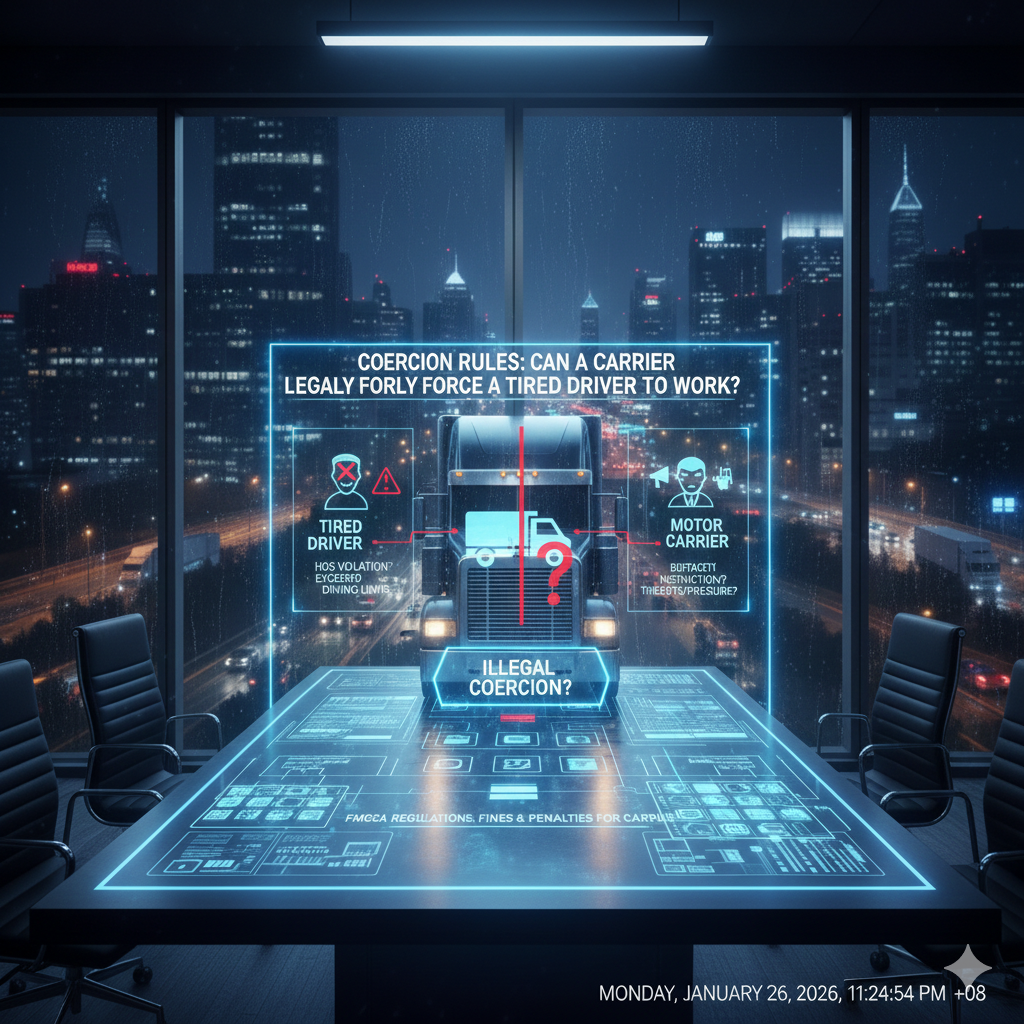
The Coercion in the Real Life
Numerous cases of coercion are of the same nature. A trucker will go to a shipper and wait several hours. The delay consumes the driving time. A dispatch or a broker mentions that the load will still have to be delivered on time. The driver reasons that it would be over speeding or that he or she is too tired to continue. The response comes back:
“You need to make it work.”
Run this or we will find somebody.
You will never get good loads now.
This does not necessarily sound as a threat, but when coupled with safety compliance, can be considered illegal coercion. The legislation does not demand screaming or written threats. Even suggested economic pressure can be on the other side.
How to Protect Yourself as a Driver
Under the pressure to drive when tired:
- Communicate clearly
Say that you are too tired to drive and get out.
- Be professional and factual
Avoid emotional language. Be safe and compliant.
- Document everything
Saved text, email, loaded information, ELD messages and call time.
- Do not falsify logs
This puts you personally in the red.
- When possible, use written channels.
Messages create evidence.
Example message:
“I am too tired to drive this car safely. It would be unsafe to continue and it would be against the FMCSA regulations. I must stop.”
This kind of statement secures you in the law.
Instructions in Filing a Coercion Complaint
In case of coercion, within 90 days, you must make a complaint with FMCSA using the National Consumer Complaint Database.
It is simple in process. You give the name of the carrier, broker, or shipper involved, the date and time of the event, the details of the load, and the description of the threats or pressure. In case you have texts, messages or call logs, then attach them.
FMCSA does not disregard such complaints and particularly when there is a paper trail. Every report enhances punishment and prevents other drivers from the same treatment.
Why These Rules Exist
Fatigue is still among the main causes of severe truck accidents. Effects of drowsy driving include slower reaction time, inability to identify hazards, lane changeovers, and microsleeps. In a car that has tens of thousands of pounds, there is a sliver of a margin of error.
The coercion rules are due to the fact that it cannot rely on economic pressure to be safe. They are trying to eliminate the fear of losing a job because of saying I am too tired. They do not see any delivery, contract, or deadline worth a life.
Drivers are not the only ones who are safeguarded by the rules. They shield families in petrol guzzlers, highway commuters, and all individuals who share a road with a commercial vehicle.
Conclusion
The carrier is not allowed to coerce a fatigued driver to work. The federal statute is clear: safety first. You are permitted as well as obliged as a professional driver to reject unsafe operation. There is a rule of coercion to safeguard your life, career and license. Once one is tired, there is no shame in quitting. It is professionalism.
In trucking there is not a price on the cost of a preventable tragedy, there is not a load, there is no deadline and there is not a paycheck.
-
Also Read This “14-Hour Rule vs. 11-Hour Rule“ post. (e.g., “Coercion often happens when a driver is pushed to ignore the 14-hour workday window.”)
-
Can Read This FMCSA Coercion Complaint Page.
FAQs
Is it because my dispatcher can fire me because I refuse to drive when I am tired?
No. In case your refusal is on safety or compliance with regulations, the termination can be considered as unlawful retaliation.
What happens when I am in HOS yet I am still tired?
You can still quit. Scheduling pressure is overridden by safety.
Are there rules concerning coercion to owner-operators?
Yes. In the case of brokers, shippers and carriers, the owner-operators are safeguarded.
What in case the pressure is subtle?
Coercion can include even the implied threats such as loss of loads, fewer miles or negative treatment.
How long do I have to report?
You have to submit within 90 days of the incident.
Note: The content published on this blog is intended solely for informational and guidance purposes. We do not offer, promote, or provide any services through this website.