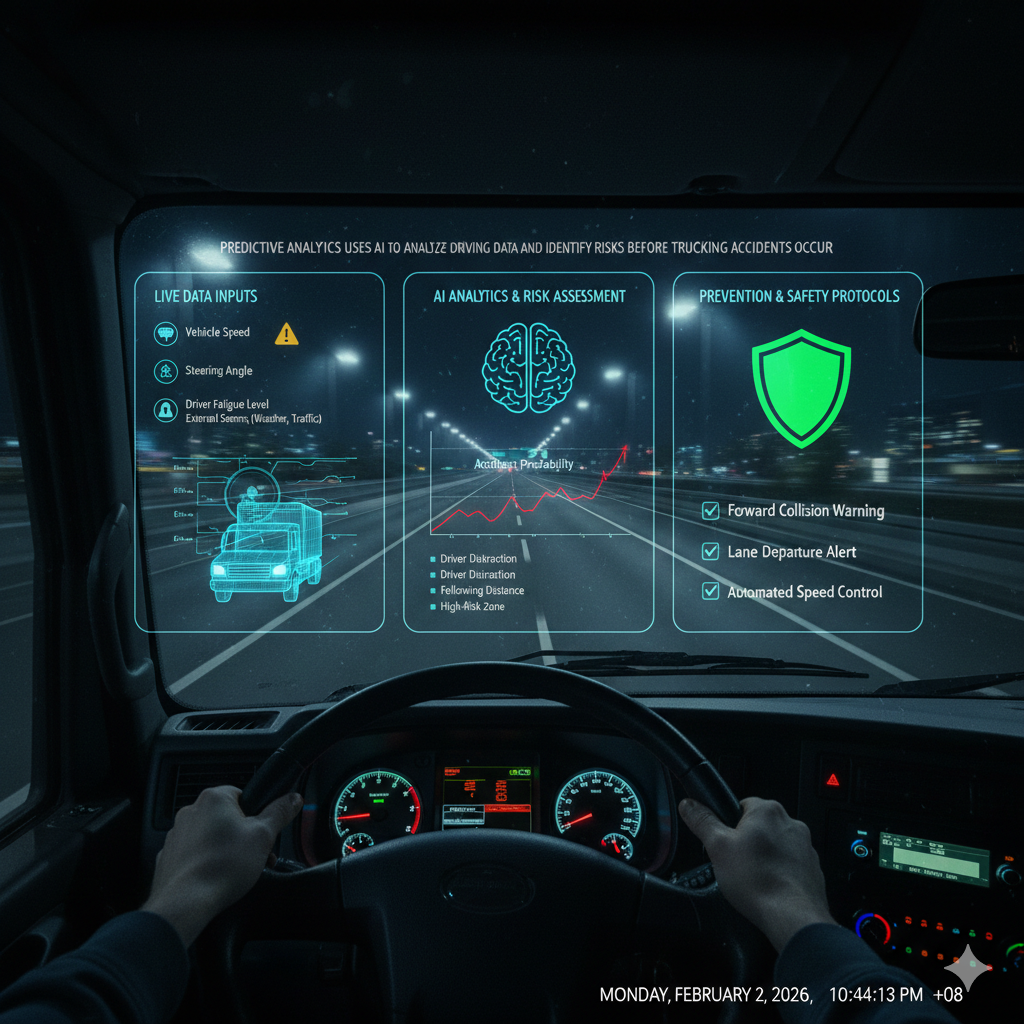
AI in Trucking: How Predictive Analytics Prevents Crashes
How does AI predict truck accidents in 2026? AI prevents crashes by analyzing “leading indicators”—small, non-crash events like hard braking, lane swerving, and driver yawning—to create a risk profile. In 2026, platforms like Motive and Street Vision report that for every one collision, there are seven “near-collisions” detected by AI. By flagging these near-misses, fleets can intervene with coaching or mandatory rest before the actual impact occurs, reducing preventable accidents by up to 40%.
The 2026 Shift: From Reactive to Proactive
Historically, safety managers looked at “Safety Scores” based on past tickets. Today, AI looks forward:
-
Fatigue Forecasting: AI doesn’t just see if a driver is tired now; it predicts when a driver will likely hit “critical fatigue” based on their specific circadian rhythm and the last 72 hours of sleep data.
-
Hyper-Local Risk Zones: AI cross-references real-time weather (like 2026 “sun glare” warnings or high-wind alerts) with historical crash hotspots to tell a driver exactly when to slow down before they reach a dangerous curve.
The trucking industry has been undergoing an enormous transformation in the past several years, and Artificial Intelligence (AI) has played a crucial role in improving safety and efficiency. One of the most radical AI applications in the trucking sector that can help prevent accidents and crashes on the road is predictive analytics. The predictive analytics is changing the management of the trucking businesses to rely on real-time information, past trends, and advanced algorithms to ensure safer transportation modes among the drivers and the general population.
What is Predictive Analytics Trucking?
Predictive analytics is defined as the application of AI-based algorithms to process large volumes of data, predict possible events and outcomes, and forecast. Within the framework of trucking, predictive analytics utilizes information of all kinds, including vehicle sensors, weather data, traffic, driver behavior, and road conditions. This enables businesses to be aware of the risks and preventive actions are taken in advance of the accidents.
Predictive analytics can deliver real-time actionable insights by integrating machine learning models, and therefore can help trucking fleets make better decisions. It can be the route adjustments due to the unfavorable weather conditions or the suggestion of the driver to have a rest after a certain amount of time, predictive analytics is already becoming an irreplaceable part of the contemporary trucking company.
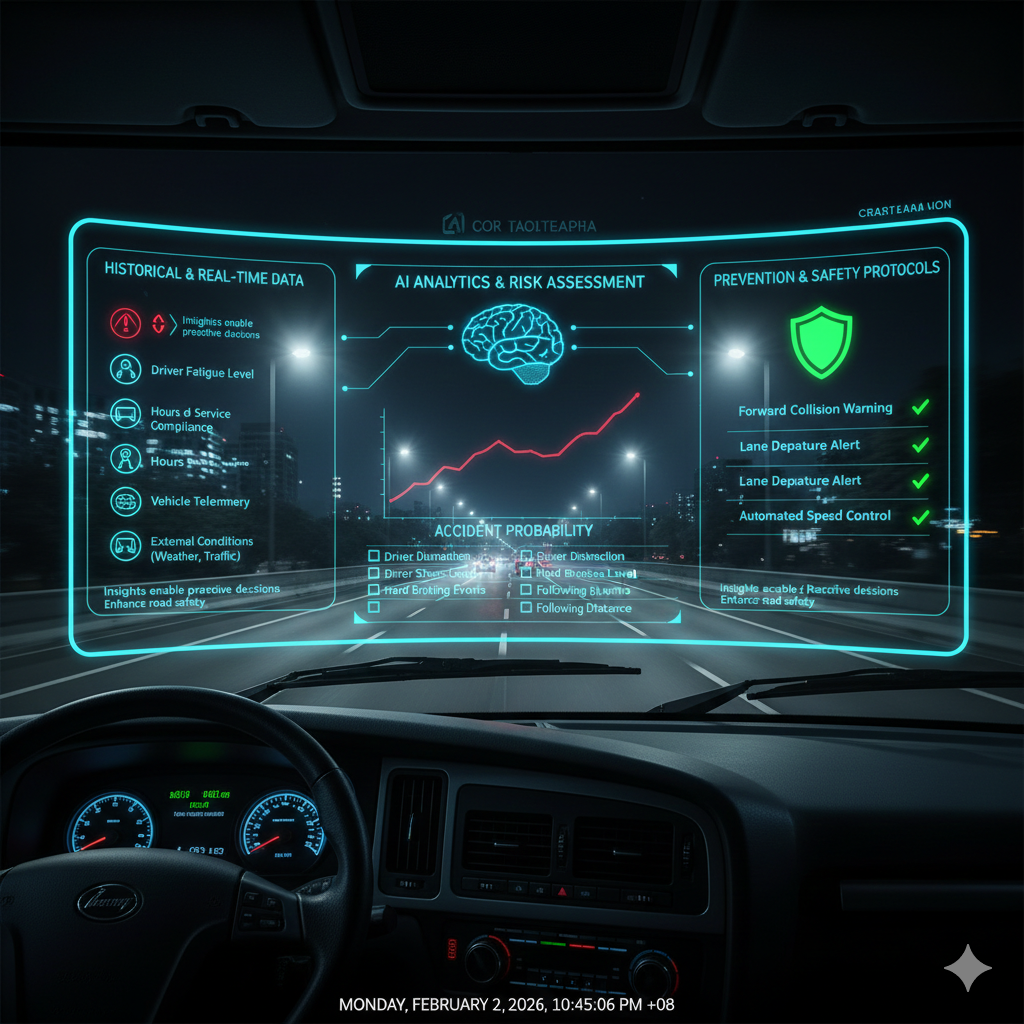
What Is Predictive Analytics And How Does It Prevent Crashes?
-
Driver Behavior Monitoring and Alert Systems
Driving error is one of the biggest reasons of truck accidents and in most instances, it is related to fatigue, over speeding, distracted driving or road rage. AI-operated cameras, sensors, and telematics systems can follow the activities of a driver in real-time and predictive analytics can be used to detect the activities of a particular driver. Such systems monitor such variables as speeding, sudden braking, lane switching, and even driver drowsiness.
The system can notify the fleet managers to take the necessary actions by alerting the driver in real time where one of the drivers is engaged in hazardous activities or notify them about the occurrence. These precautions can prevent accidents because the drivers drive with care, they are keen or take the necessary rest before they become exhausted.
-
Road Network Optimization and Weather prediction
Unfavorable weather conditions such as snowstorms, heavy rain, or fog are very dangerous to truck drivers, particularly when it is over long distances. Predictive analytics applications can be used to predict hazardous weather conditions on a route and recommend alternative routes using real-time weather information.
Moreover, AI is able to take into account such aspects as road closures, traffic jams and even construction areas in order to offer the most efficient and safest paths. Trucking companies can reduce the risk of the occurrence of accidents caused by environmental factors by actively changing routes and schedules.
-
Avoiding Mechanical Failures
Another cause of the trucking accidents is mechanical problems, that is, breakdown of brakes, tire explosion, or engine breakdowns. Predictive analytics will be able to check the well-being of the parts of a truck using Internet of Things (IoT) sensors that continuously monitor the performance of the engine, tire pressure, brake efficiency, etc.
This data can be used to predict potential mechanical failures before they occur with the help of predictive analytics. In one instance, when the system detects that the performance of the brake is low or the tire pressure is not within the normal range, it can advise the maintenance teams to perform preventive maintenance in order to make sure that the possibility of a breakdown or an accident is low.
-
Fatigue and Health of Drivers
One of the major causes of truck accidents is driver fatigue. Extended time on the road may result in slow reaction and decision making. AI-assisted fatigue sensors are based on sensors and biometric information to track the alertness of the driver, eye movement, and even heart rate. In case the fatigue is observed, the system can remind the driver to take a rest and avoid drowsy driving accidents.
Also, predictive analytics can be used to track the trends of driver health, including sleep patterns or stress levels, which may be causing fatigue. AI is not only able to avoid accidents but also improve the general well-being of drivers by encouraging healthier driving behaviors.
The AI in regulatory compliance
Regulatory compliance becomes critical in the trucking industry in terms of safety and efficiency. The Electronic Logging Device (ELD) regulations among others are designed to deal with issues that could lead to driver fatigue, like monitoring and recording driving hours, which would have to be followed by the trucking companies with the work/rest schedules. The issue of operating in the complicated regulatory setting is alleviated with the help of AI-powered predictive analytics. Such systems also allow tracking driving hours, rest time, and health condition of the driver in real-time, with the use of data provided by different sources, including vehicle sensors and biometric measurements, to evaluate the risk of fatigue.
AI systems are able to notify drivers and fleet managers when the driver is approaching legal boundaries or indicates that they are stressed, thereby improving safety and compliance, unlike manual tracking. In addition to ELD compliance, AI-based tools allow generating reports automatically during audits, which allows fleet managers to gain an overall understanding of driver behavior in a short time and adhere to the safety standards. Also, AI has the ability to propose management upgrades, regarding past information.
With new regulations arising, in many cases concerning the effects of environmental issues and testing of autonomous vehicles, AI-based predictive analytics will become essential to comply. The technology is not only helping to meet the current regulations, but it also helps fleets to adapt to new rules in a short period of time. Also, with the help of the data analysis that is constantly being conducted, the AI will be able to identify and resolve minor compliance issues before they escalate into violations, thereby saving fines.
To conclude, AI adoption is essential to enable trucking companies to continue operating within the limits, be safe, and more efficient in their operations in both short-term and long-term. The future of compliance in trucking lies in the fact that AI predicts, monitors, and optimizes operations to protect people and the environment and minimize the possibility of violations.
The Future of AI in Trucking: A Safer, More Efficient Industry
With the further development of the AI technology, possibilities of predictive analytics use in trucking are practically unlimited. Predictive analytics will be part of the industry in the future, not only autonomous trucks, but also in the case of full integration of the fleet management system.
Besides the decreased rate of accidents, AI-powered predictive analytics help trucking enterprises to enhance fuel efficiency, decrease the cost of operations, and increase customer satisfaction. By having safer roads, fewer accidents, and a more dependable fleet, predictive analytics is predetermining a safer and more sustainable future of the trucking industry.
Conclusion
Predictive analytics in trucking is transforming the industry in terms of safety, efficiency, and risk management. Using the strength of AI to foresee and avoid accidents, trucking companies are setting the stage in the future, in which the number of accidents will decrease, and roads will become safer for everyone. With the further development of technologies, predictive analytics will be even more advanced and will lead to other further improvements of how the trucking industry functions and secures its drivers.
In the case of trucking firms that want to be ahead of the curve, predictive analytics as a part of fleet management strategy is no longer a luxury, but a necessity. With the adoption of such a new and innovative technology, the trucking industry will be able to make safety the most significant consideration, and no driver, cargo, or community will be subjected to harm.
-
Read This Blog “Dashcam Admissibility“ post. (e.g., “While predictive AI warns you before a crash, dashcam footage provides the visual proof needed for court.”)
-
Check this 2026 Motive AI Road Safety Report or Fatigue Science.
FAQS
- So what are predictive analytics in trucking?
Predictive analytics uses machine learning and AI on real-time vehicle, driver and environmental data to forecast the likelihood of a risk event happening such as mechanical failure or unsafe driving.
- How can AI help to stop crashes between trucks?
AI software monitors driving patterns (e.g., aggressive braking, sideways road) and the environment around the driver to inform the driver or fleet owner of the dangerous condition and avoid accidents before they happen.
- Do these AI safety systems prevail in the U.S. trucking Industry?
Yes-AI is being introduced into fleets, including such tools as advanced driver assistance systems (ADAS) and predictive safety analytics, and they are causing the reduction in accidents to shrink dramatically.
- Is predictive analytics able to enhance the behavior of drivers?
Absolutely. Following the information about speed, braking and fatigue, the AI can identify the risky behavior and guide the fleets to instruct the drivers to become less risky and minimize the possibility of accidents.
- Are these technologies causing less safety problems as a result of maintenance?
Yes–predictive analytics can alert the possibility of a part of the vehicle, such as brakes or tires, to fail and the maintenance is performed before it results in risky failures.
Note: The content published on this blog is intended solely for informational and guidance purposes. We do not offer, promote, or provide any services through this website.






Comment on “AI in Trucking: How Predictive Analytics Prevents Crashes (2026)”