Dashcam Admissibility: Can Your In-Cab Video Be Used Against You?
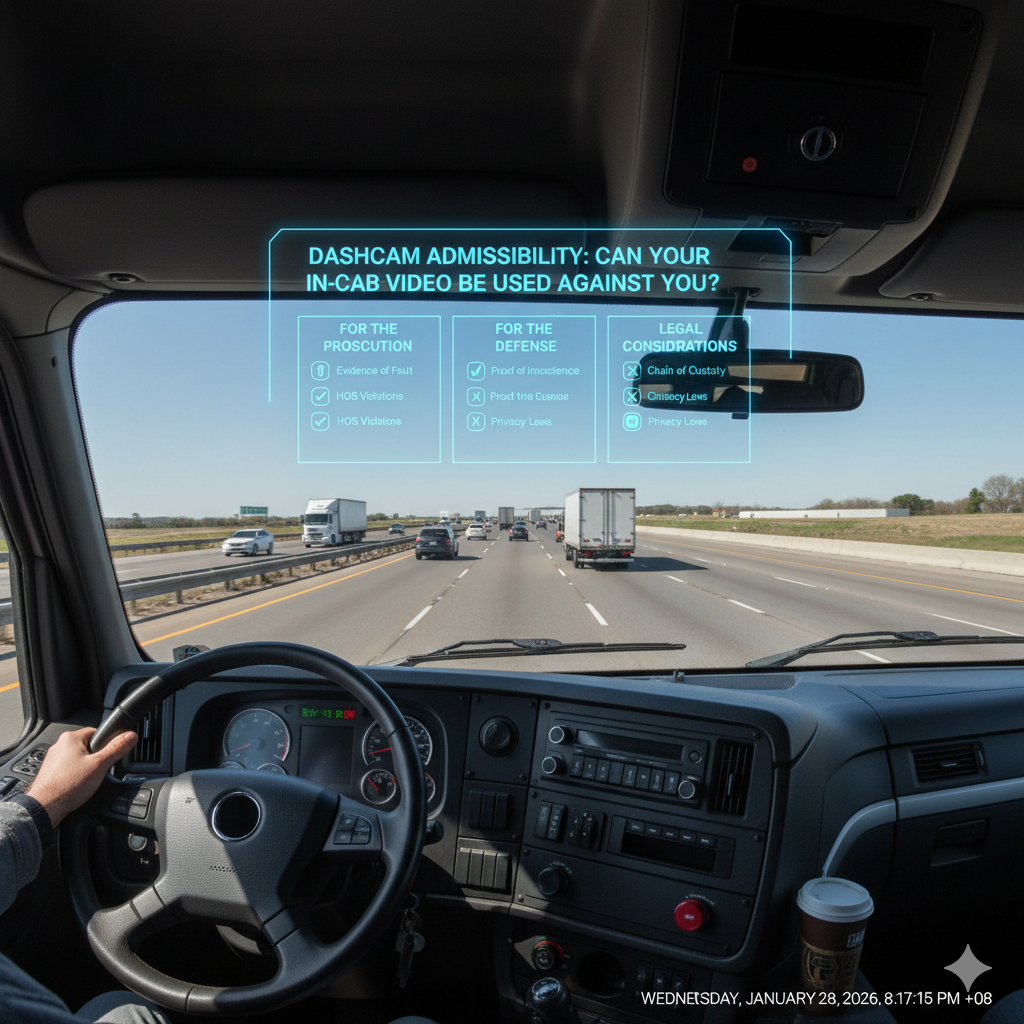
Is in-cab dashcam footage admissible in court in 2026? Yes. In the USA, dashcam footage (both outward and inward-facing) is generally admissible as long as it is authentic, relevant, and unedited. Under the Rules of Evidence, video is considered “demonstrative evidence” that can override witness testimony. While you own your footage in a personal vehicle, commercial in-cab video belongs to the carrier and can be subpoenaed by plaintiff attorneys to prove driver fatigue, distraction, or “coercion.”
The Two-Way Street: Outward vs. Inward Cameras
-
Outward-Facing: Your best friend. It proves you had the green light, were cut off, or maintained your lane. Courts almost always admit this as objective truth.
-
Inward-Facing (Driver-Facing): The “Prosecutor in the Cab.” In 2026, this footage is used to look for “micro-expressions” of fatigue or the glow of a smartphone on a driver’s face.
The Privacy Battle: When is Video Inadmissible?
In 2026, the admissibility of your video often hinges on State Privacy Laws:
-
Audio Recording (The Wiretapping Trap): 11 states (including CA, IL, and FL) are “All-Party Consent” states. If your dashcam records audio of a private conversation without consent, that audio—and sometimes the video—may be thrown out.
-
Expectation of Privacy: Courts generally rule there is no expectation of privacy while driving a commercial vehicle on a public road. However, recording while a driver is in the sleeper berth during an off-duty reset is a major legal “no-go” and often considered a privacy breach.
Dashcams are also becoming a necessity to motorists in the United States. In-cab dashcam footage is priceless whether it is to keep a check on road conditions, give evidence against a possible accident or even defend the drivers against false accusations. However, what would happen when the video you have recorded is used in a court of law? Is it possible to use your dashcam video against you?
In this blog, we are going to explore the concept of dashcam admissibility with the legal issues, the challenges that may arise and the major considerations which determine whether your in-cab video can be used against you.
Understanding Dashcam Evidence and Its Use in Legal Matters
Dashcams have become popular due to the fact that they can offer a reliable time-stamped account of events. To a great number of drivers, dashcam videos are an insurance mechanism against future accusations, be it innocence or a source of extra information in case of a crash.
It should be noted, though, that dashcam footage like any other evidence is subject to the examination of the law. Its admissibility in court may even be subject to the mode of acquisition, the circumstance under which it is used and even certain state laws.
Is it possible to use Dashcam Video as evidence against you?
Though dashcam footage is thought to be one of the sources of protection, the footage may even be used against the driver in certain situations. That is a recap of the instances when dashcam video footage can be used against you:
-
Evidence of Negligence or Reckless Driving:
Should your dashcam record dangerous driving practices such as over speeding, red lights, failure to give way to pedestrians, then it can be used as a source of evidence of negligence or careless driving. This can be legal in terms of being fined, penalized or even charged with a crime.
-
Involvement in a Collision:
In case a crash happens in which you are the reason, your dashcam might be used to prove responsibility. Dashcam footage may be very important in proving liability in instances of personal injury claims or insurance disputes.
-
Violating State or Federal Laws:
Dashcams can also record the activities that are against certain state or federal laws such as texting and driving, distracted driving or drunk driving. Such footage may be utilized in the court to prove the violation of traffic laws.
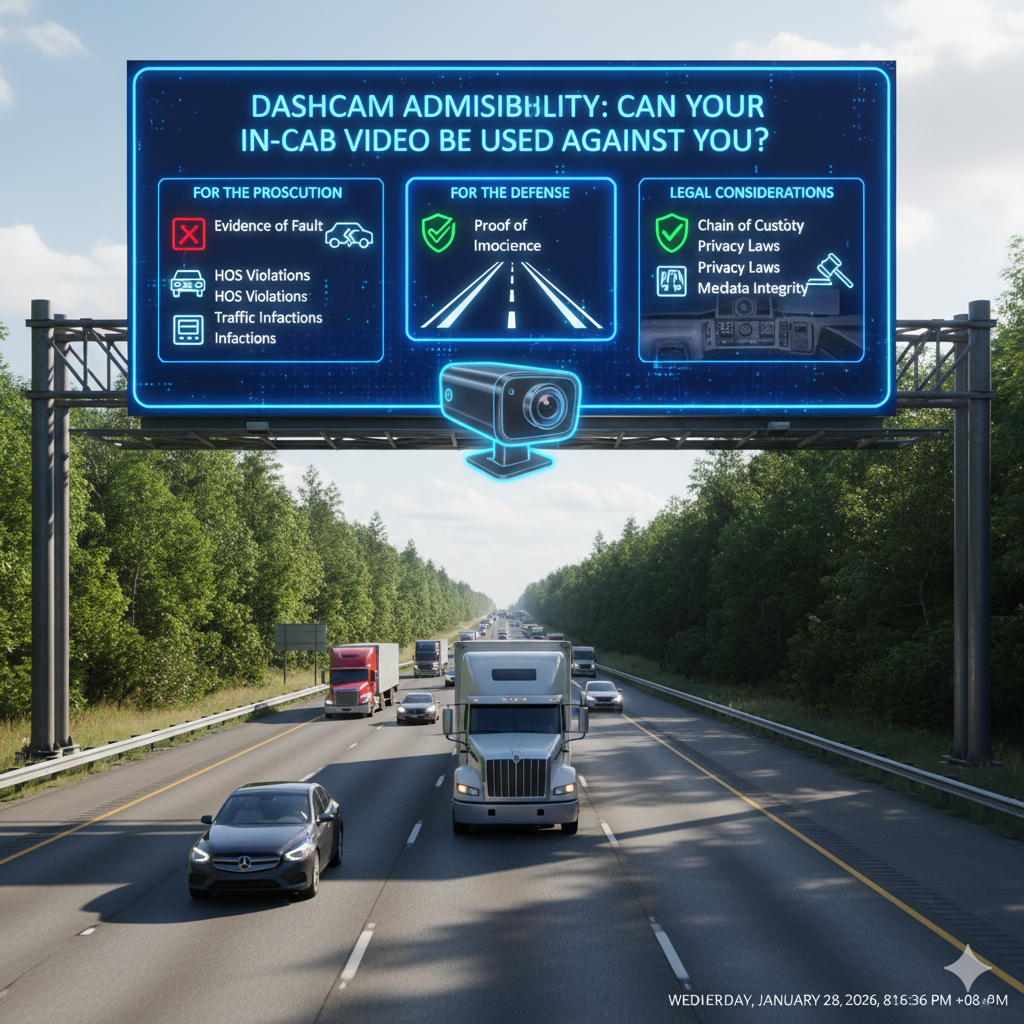
Key Factors That Determine the Admissibility of Dashcam Footage
Although dashcam footage may be used against you, a number of issues can be used to determine whether or not it is admissible in court. These include:
- Legality of the Footage’s Acquisition:
The privacy of people (like wiretap laws) is a type of law that may affect the use of your dashcam recording in a courtroom in certain states. An example is that in case the video records conversations without permission (e.g. live recording inside the vehicle), it might not be admissible. - Chain of Custody:
The footage should also be well maintained and kept to be used as evidence. This implies that clear records should be made in the manner in which the footage was handled, stored and transferred. The footage might be challenged in court in case the chain of custody is compromised. - Accuracy and Authenticity of the Footage:
Dashcam footage should be precise and should not be doctored with. Courts will seek to find the evidence that the video has been modified or altered. Any discrepancies in the video can be claimed to cast doubt on the authenticity of the video including missing links in time or a mismatch in timestamps. - Relevance to the Case:
The video should be closely related to the case under consideration. The dash camera footage might not be admitted in case it lacks useful information or does not demonstrate a material fact in the case.
Dashcam Footage and Privacy Concerns
One of the biggest issues with dashcam footage is the question of privacy. Although it is not against the law to capture videos in your car, there are some circumstances where the passengers or pedestrians can allege that their privacy right has been infringed upon when the videos are recorded and they are not given the consent to access the videos.
Certain states are more strict with the laws that regulate video and audio recordings in personal space. In such situations, although the recording may be made in the personal use of the footage, it may not be allowed to be used in a court without prior consent.
The Impact of Dashcam Footage in Personal Injury Claims and Insurance Disputes
Dashcam footage may be considered an effective evidence in case of a car accident or a personal injury lawsuit. It can provide:
- Proof of Fault: Dashcam videos can be used to prove the culprit in an accident, which is very important in personal injury cases and insurance claims.
- Insurance Fraud Prevention: When fraudulent claims are being made, dashcam footage would be used as a defense, as it can be used to demonstrate that there was no accident as alleged by the other party.
- Clear Documentation of the Incident: Dashcam footage can be used to give the objective view of the events prior to the impact and after the crash which can be used to solve the conflict in a short period in the case of an accident.
What Should You Do to Protect Yourself?
As a driver, you can take several measures to defend yourself in case you have a dashcam:
- Know Your State Dashcam Laws: It has laws on dashcams in each state and the laws vary with each state in terms of privacy and recording of video/audio. Get yourself acquainted with these laws so that you can avoid pitfalls in the law.
- Install a Dashcam with Secure Storage: Make sure that you have a Dashcam that is used to record and that the footage is not easily edited. There are also some hi-tech dashcams that have encrypted storage to provide additional security.
- Periodically Review Your Footage: Review your dashcam footage periodically to ensure that it is recording correctly and it is storing the data safely.
- Call an Attorney: Once you have been implicated in an accident or a legal matter, and your dashcam footage may somehow be used in your favor, then it is always a good practice to seek the advice of an attorney who has dealt with the use of dashcam footage in your favor.
Conclusion
Dashcam can prove handy in self-defense and as evidence during an accident or a court proceeding. It should be noted though, that in some cases, your video in the cab can be turned against you. Learning the laws about dashcam admissibility, making sure that your footage has been legally obtained, and how to use it to your benefit, one can easily bypass the legal intricacies of dashcam evidence.
Have you experienced the situation when your dashcam video was used in a court case? Share your case with the comments below or contact us and we can discuss with you how dashcam footage can change your case.
-
Read this for more information “Black Box Data“ post. (e.g., “While the Black Box provides the math, the dashcam provides the ‘Why’—linking mechanical data to human behavior.”)
-
Also Read This American Bar Association: Rules of Evidence.
Disclaimer: The information that is posted on this blog is purely informational and guidance. We are not selling, marketing or offering any services using this site.
FAQs
1: Does dashcam footage have any place in the court?
Yes, dashcam videos can be used in court as evidence, though their admissibility depends on such factors as the legality of their recording, their applicability to the case, and the fact of their manipulation.
2: Does dashcams have any privacy issues?
There might be privacy concerns whereby the dashcams may record personal conversations or activities against consent. Recording audio or video without consent is against the law of wiretapping in certain states, and the video might not be admissible.
3: Does dashcam footage work against the driver?
Yes, in case the video depicts the driver with reckless driving, speeding or other types of traffic offense, it can be used against the driver in legal proceedings, including personal injury lawsuits or criminal proceedings involving negligent driving.
4: Is dashcam video effective in personal injury cases?
Dashcam footage may be very instrumental in a personal injury claim since it acts as clear evidence of what has happened in an accident; it assists in proving the fault and eliminating fraudulent insurance claims.
5: What is the impact of state laws on the admissibility of dashcams?
The state laws on dashcam footage are different, particularly on privacy. Certain states have stringent legislation on video/audio recording which may affect admissibility of footage in court, especially in cases where the recording was done without permission.