
GPS Spoofing in Freight: The Legal Consequences of Location Fraud
Is GPS spoofing legal in the trucking industry? No. Under U.S. Federal Law (including 18 U.S.C. § 659 and 47 U.S.C. § 333), the intentional manipulation of GPS signals to misdirect freight or falsify logs is a crime. In 2026, the FMCSA has intensified enforcement through the MOTUS registration system, which uses identity verification to combat “data spoofing.” Carriers caught spoofing locations face fines exceeding $16,000 per violation, immediate revocation of operating authority, and potential federal imprisonment for “Theft from Interstate Shipment.”
How GPS Spoofing Works in Freight Fraud
Criminals and “chameleon carriers” use several tactics in 2026 to commit location fraud:
-
Simulated App Data: Third-party services that generate fake “pings” for tracking apps like Macro point or Four Kites.
-
Hardware Spoofers: Low-cost devices that overpower authentic satellite signals, forcing the ELD or GPS unit to “jump” to a false location.
-
VOIP & Emulator Fraud: Using virtual phones to simulate a driver being in Chicago when the cargo is actually being diverted to a “dark warehouse” in another state.
The freight transportation and logistics sector is at the crossroads in 2026. Although supply chains are now more than ever technologically connected and data-driven, criminals are using the same connectedness to commit fraud, such as GPS spoofing. Such a fraudulent activity of altering the physical address of freight ships or containers is not only a security problem: it has severe legal and financial implications in the U.S. legislation.
This is an overall guide where we are going to discuss what GPS spoofing is, how it is being applied in freight fraud, the laws that exist in the United States, actual life examples, and the fines that a company or individual can be subjected to, as well as how to protect your operation.
What Is GPS Spoofing?
GPS spoofing is a situation in which a system or a device is fooled into thinking that it is not in a certain position, but rather somewhere else. This can happen through:
- Hardware manipulation: Sending fake GPS signals to replace actual satellite signals.
- Software manipulation: Manipulating location information reported by a tracking system or a device.
GPS information is essential in freight logistics. The location tracking in real-time enables shippers, carriers, brokers, and insurers to track the movement of freight, schedule pickups/deliveries, evaluate risk, and determine compliance with the service. In case such data is manipulated, the impact may trickle down the supply chain.
How GPS Spoofing Is Used in Freight Fraud
Freight GPS spoofing is not science fiction: it is a very real danger that criminals use to commit strategic theft of cargo and commit fraud. Here’s how:
Concealing Stolen Loads
By changing the GPS positioning, criminals can make stolen cargo look like it is on its authorized path to allow them to sell or dispose of the goods before the theft is reported.
Falsifying Pickups or Deliveries
With manipulation of GPS data, fraudsters are able to provide evidence of delivery or pickup time, and make it appear that freight has been collected or delivered at the right time/location when it has not. Such fraud usually results in loss of money and complicated arguments between shippers, carriers and insurers.
Double‑Brokering and Load Diversion
Spoofed location information may be used to facilitate double-brokering fraud, in which carriers may carry loads blindly on the basis of fraudulent or counterfeit load postings. Confirmed location history complicates the detection of the fraud.
Masking Hijackings
It can also persist in supplying the fake data to dispatch systems once a vehicle has been hijacked thus making the process more time-consuming to detect and act upon.
Is GPS Spoofing Legal in the USA?
Short answer: No – particularly when it is done to defraud, commit fraud or disrupt legitimate operations.
Under U.S. federal law:
Federal Communications Commission (FCC) Regulations
The FCC highly prevents the use, sale, or operation of devices that affect the GPS or any other radio communication. These are jammers and other devices that are used to transmit in the GPS frequencies without permission.
- Such bans fall under the FCC Part 15 and Communications Act.
- Violation may lead to huge fines, device seizure and even criminal penalties.
Federal Criminal Law
Although no one federal law exists that states that GPS spoofing is illegal, when used, the act becomes illegal:
- To engage in a fraud, rob or defraud.
- In order to meddle with interstate trade.
- To impede law enforcement or safety systems.
As an illustration, the transportation of stolen freight or interstate commerce fraud involving cargo theft may attract prosecution under laws like 18 U.S.C. SS 2314 (Transportation of stolen goods), that attracts up to 10 years of imprisonment and fines.
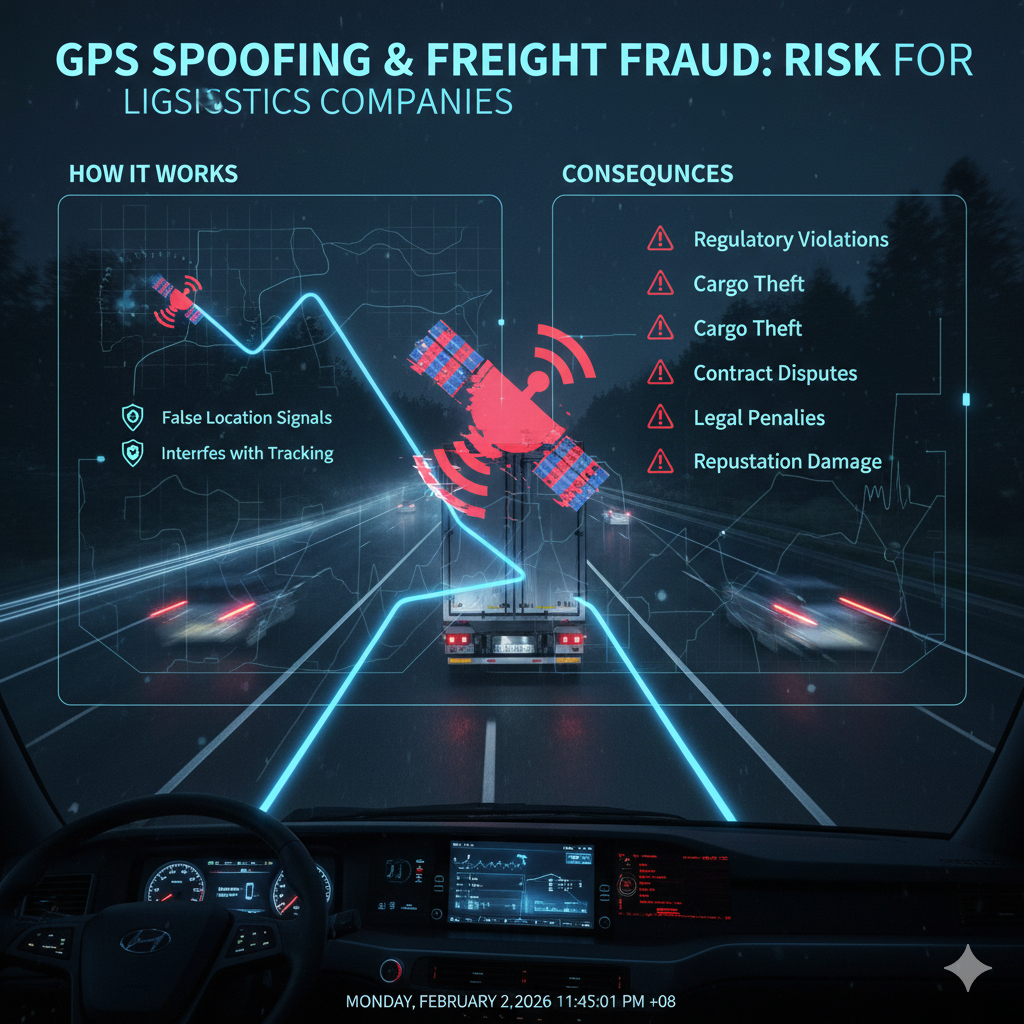
Legal Consequences for GPS Spoofing & Location Fraud
The legal implications will be based on the application of the spoofing. Some legal frameworks are involved in freight situations:
1. Communications Law Violations
Carrying out or utilizing a GPS jammer/spoofer which disrupts the authorized satellite communications is unlawful and prosecutable by the FCC. Fines may amount to hundreds of thousands or even millions of money to companies and individuals.
2. Fraud & Theft Charges
Defendants can be charged with: When the theft of cargo or freight fraud occurs through the aid of GPS spoofing, the defendants may be charged with:
- Federal fraud charges
- Interstate theft charges
- Conspiracy or organized crime counts.
For example, when a violator relies on the spoofed data to cover stolen goods carried between the states, federal prosecutors may charge stealing and fraud crimes with severe jail sentences.
3. Civil Liability
Civil claims made against the parties of GPS location fraud are usually sought against companies who have fallen victim to it in the following:
- Loss of freight value
- Business interruption
- Higher insurance premiums.
- Reputational harm
An agent or an agent making dubious use of location information to avoid a contract can be sued.
The Real Cost of GPS Spoofing in Freight
GPS spoofing is not only expensive in fines: the financial consequences of the logistics ecosystem are enormous:
- Carriers may lose hundreds of thousands of dollars directly per incident.
- The U.S. supply chain incurs tens of billions of dollars each year because of cargo theft and fraud.
- The insurance rate increases, late deliveries, reduction in customers and logistical inefficiencies are all secondary losses.
Since GPS spoofing remains a significant threat to the freight and logistics sector, proactive freight operations are approaching it with a multi-layered approach to counter the increased threat. This is aimed at improving security, ensuring the integrity of data through GPS and preventing fraud.
Multi‑Source Tracking
There has been an increasing adoption of multi-source tracking systems by logistics companies as a way of cross-checking GPS information with other real-time data points, like cellular signals, Wi-Fi connections, and telematics. The combination of this data enables the operations to detect anomalies in routes or discrepancies in locations that may indicate that spoofing is taking place. Through the combination of various sources of data, anomalies are more easily identified and resolved before they can create a big disturbance.
Anti‑Spoofing Technology
In order to fight GPS spoofing directly, state-of-the-art anti-spoofing technology is being implemented. These devices have advanced GPS receivers and signal authentication devices which can mark abnormal signals and check the correctness of location information. This security layer will not allow false information to get into the system, and it will be useful in guaranteeing the security of the freight and integrity of the operations.
Verification Protocols
The logistics firms have also enhanced their verification procedures and have initiated more stringent documentation procedures and real-time warnings in case of inconsistencies or suspicious activity in route data.
Training & Incident Response
Lastly, businesses are enabling their employees, particularly motorists, dispatchers, and security personnel, with skills and resources to be able to identify GPS spoofing indicators. Companies can also react fast to possible threats by training the staff on how to notice irregularities, like sudden changes in location or deviations along the route, and minimize the risk of fraud in general. This preventive training will allow responding to any abnormalities of GPS processes rapidly, which will be an extra security measure to safeguard the business and its customers.
Conclusion
The problem of GPS spoofing in the freight business is not peripheral; it is an emergent aspect of supply chain crime that integrates traditional theft with cyber-based deception. GPS spoofing is not allowed to be used to defraud, to disrupt, or interfere with the lawful operations. The awareness of the legal implications that this practice can cause is paramount in the United States by logistics professionals. The penalties are very harsh besides financial fines, civil liability, and criminal prosecution. The most effective defense mechanisms against this kind of location fraud are technology and vigilance when it comes to defending yourself.
The legal and technical systems that safeguard the freight business need to change alongside the industry. Companies that are in the state of constant awareness and take preventative action will be best placed to minimize risk, legally and operationally.
-
Read This “AI in Trucking“ post. (e.g., “Predictive analytics can now detect the subtle ‘noise’ of a spoofed GPS signal before the cargo is diverted.”)
-
Also Read This Post FMCSA Registration Modernization (MOTUS)
FAQs
- What is the legislation on GPS spoofing in the US?
GPS spoofing, which disrupts authorized communication systems, is subject to the FCC regulations, which prohibits jamming or unauthorized transmission of GPS frequencies. The offenders are punished with fines and machinery confiscation.
- Do GPS spoofing and criminal charges in freight cases go hand in hand?
Yes. Federal theft and fraud laws may be utilized when a spoofing is applied in order to facilitate theft of cargo, fraud, or misleading transportation practices across state lines, which may result in imprisonment and hefty fines.
- Do you know any valid applications of GPS spoofing technology?
Research, system testing, or military applications that are highly controlled are the only limited instances where technology that is similar to spoofing is used. Nevertheless, it is illegal to use it to defraud commercial systems or disrupt civilian navigation.
- What are the fines imposed by the FCC on unlawful jamming of GPS?
FCC has fined tens of thousands and tens of millions of dollars on GPS jamming equipment marketers and users.
Note: The content published on this blog is intended solely for informational and guidance purposes. We do not offer, promote, or provide any services through this website.