
Cases on Defense of Accident in the USA: How the Law Protects (and Challenges) Carriers
How do courts decide accident defense cases in 2026? US courts decide accident defenses by evaluating whether the defendant (the driver/company) exercised “Ordinary Care” under the circumstances. In 2026, this is proven by cross-referencing ELD data and AI dashcams against the specific legal defense raised, such as the Sudden Emergency Doctrine or Comparative Fault. If the defense proves the accident was truly unforeseeable or caused by the plaintiff, the defendant’s liability is reduced or dismissed.
The 3 Most Powerful Defenses in 2026 Trucking Litigation
1. The Sudden Medical Emergency Defense This is a high-stakes defense where the driver claims a total loss of control due to an unforeseeable health event (e.g., a sudden heart attack or stroke).
-
Legal Meaning: The event must be sudden, leave the driver unconscious/incapable, and—most importantly—be unforeseeable.
-
2026 Standard: If the driver had a history of heart issues but failed to disclose it on their DOT physical, this defense will fail. Courts now subpoena pharmacy records to see if the driver was skipping blood pressure medication.
The U.S. law of defense of accident implies that an individual is not supposed to be criminally or civilly responsible in case some harm was done unintentionally, carelessly, or without the intention, negligence, or recklessness. Simply put, it claims that the evil result was an accident and that it could not have been averted reasonably. According to U.S. criminal law, in order to be convicted one must have committed a guilty act (actus reus) and have a guilty mind (men’s rea). When the act was simply by accident, one does not have the necessary intent to commit a crime. (Cornell Law School, Legal Information Institute).
The courts also acknowledge the fact that not every injury is caused by wrongdoings. In case an event was not caused by fault, e.g., a sudden mechanical breakdown, an unexpected medical event, this may be considered a legal accident, not a wrongful act (Restatement (Second) of Torts SS282).
Difference Between Legal Conduct Types
- Intentional acts: The person meant to cause harm (e.g., assault).
- Negligent acts: The person failed to act with reasonable care.
- Purely accidental acts: Harm occurred without intent or negligence.
The accident defense works because law does not punish people for unavoidable misfortune.
Key Elements
- No intent to harm
- No recklessness
- No negligence
- Unforeseeable event
How the Defense of Accident Works in Criminal Law
In criminal law, accidental defense is relevant in cases whereby the defendant can prove that the dangerous outcome was not caused intentionally. The majority of the crime in the United States involves evidence of mens rea, i.e. the defendant must have acted knowingly, intentionally or recklessly (Model Penal Code SS2.02).
In case of injury or death due to an error, mechanical failure, or unforeseeable circumstance that lies outside the control of the individual, the prosecutors will not be able to demonstrate the necessary state of mind. Through this, the defendant cannot be convicted under the law.
As an illustration, when a gun is fired as a result of a production flaw and not by the person, the court can deem the occurrence as an accident and not a crime.
When an Accident Eliminates Criminal Liability
- Firearm accidents (e.g., unintentional discharge without reckless handling)
- Fatal falls (no pushing, no dangerous conduct)
- Accidental injuries during lawful activities
When Accident Is NOT a Defense
The defense fails when the defendant engaged in risky or unlawful behavior:
- DUI crashes – driving while intoxicated creates criminal liability (NHTSA) Drunk driving
- Reckless driving
- Using a dangerous weapon carelessly
Personal Injury and Civil Case Accident Defense
In civil law, defense of an accident is concerned with the negligence of the defendant. Negligence is involved when an individual fails to exercise reasonable care and then causes harm which is foreseeable (Cornell Law School).
In order to succeed in a personal injury lawsuit, the injured party should demonstrate:
- A duty of care existed
- The duty was breached
- The breach caused harm
- The harm was foreseeable
If the defendant proves the injury resulted from an unavoidable accident, then no breach of duty occurred, and liability is avoided.
Accident vs Negligence
- If harm was predictable → negligence
- If harm was unpredictable → accident
Courts rely heavily on foreseeability, a key tort law principle. If a reasonable person could not have anticipated the harm, the defendant is not legally at fault (Palsgraf v. Long Island Railroad Co., 248 N.Y. 339 (1928)).
Common Applications
- Slip-and-fall cases
- Workplace injuries
- Traffic collisions
Unavoidable Accident Defense Explained
An unavoidable accident is a type of accident defense that applies when harm results from circumstances beyond anyone’s control, even when reasonable care was exercised. Courts recognize that not every injury is caused by negligence (Texas Supreme Court – Reinhart v. Young, 906 S.W.2d 471).
This defense is especially common in auto accident and product liability cases. If evidence shows that no party could have prevented the event, liability does not attach.
Typical Causes
- Sudden mechanical failure
- Extreme weather
- Medical emergencies
Examples
- Tire blowouts despite proper maintenance (NHTSA) Tire Safety
- Black ice on highways
- Sudden heart attacks while driving
In these cases, courts focus on whether the driver or defendant acted reasonably before the incident, not the outcome itself.
Famous & Real Defense of Accident Case Examples in the USA
Real U.S. courts have repeatedly accepted the defense of accident when evidence shows the defendant lacked intent or negligence.
Criminal Case Study – Unintentional Shooting
One of the brightest examples is United States v. Brown, 117 F.3d 471 (11th Cir. 1997). Here, a gun fired in a fight killing someone. The accused argued that the shooting was not meant to be and it was an accident. According to the verdict of the court, due to the lack of evidence of intent or recklessness, the defendant was not guilty of intentional homicide. source
The case demonstrates one of the major principles of criminal law: without being able to prove intent, criminal liability does not go through.
Car Accident Defense Case – Sudden Brake Failure
In Womack v. In the case of Banner Bakery, Inc., 80 Ariz. 353 (1956), the driver was involved in a fatal accident when the brakes broke out of the blue. The court decided that mechanical breakdown could be considered an unavoidable accident provided the driver did not receive any warning, and he was in good condition of the vehicle. The driver had no legal negligence because the failure was unpredictable.
Workplace Accident Case-Machinery Failure
One of the conditions that caused failure of safety gears resulting in an accident is in Seaboard Air Line R.R. v. Horton, 233 U.S.492, (1914), where a railroad worker was injured in an accident. The U.S. The Supreme Court clarified that an employer who provides the appropriate equipment and upholds safety precautions is not negligent but the accident happens due to a mechanical breakdown. Source. The case continues to inform the current law of injury in the workplace.
Self-Defense vs Accident
In People v. A gunshot was fired during an attempt to scare off an attacker by the defendant as the case of Carmen, 36 Cal.2d 768 (1951), demonstrates. According to the ruling of the California Supreme Court in cases where injury is caused without intent during a legal act, there is the defense of accident. Source. In this case, the lack of intention equated to lack of criminal liability
How Courts Decide Whether Something Was an Accident or Negligence
Courts do not only follow claims but look at evidence and conduct in a bid to determine whether an occurrence was an accident or negligence. According to U.S. tort law, negligence is a situation in which a human being does not apply reasonable care (Cornell Law School).
Judges and juries analyze:
- Conduct before the event (Was the defendant acting safely?)
- Risk level (Was the activity dangerous?)
- Safety precautions (Were safety rules followed?)
- Witness testimony
- Expert evidence
In Palsgraf v. Long Island Railroad Co., the court ruled that liability only exists when harm is reasonably foreseeable.
Evidence used by courts
- Police reports
- Accident reconstruction
- Surveillance footage
- Medical reports
If the injury was not foreseeable and precautions were taken, courts classify it as an accident, not negligence.
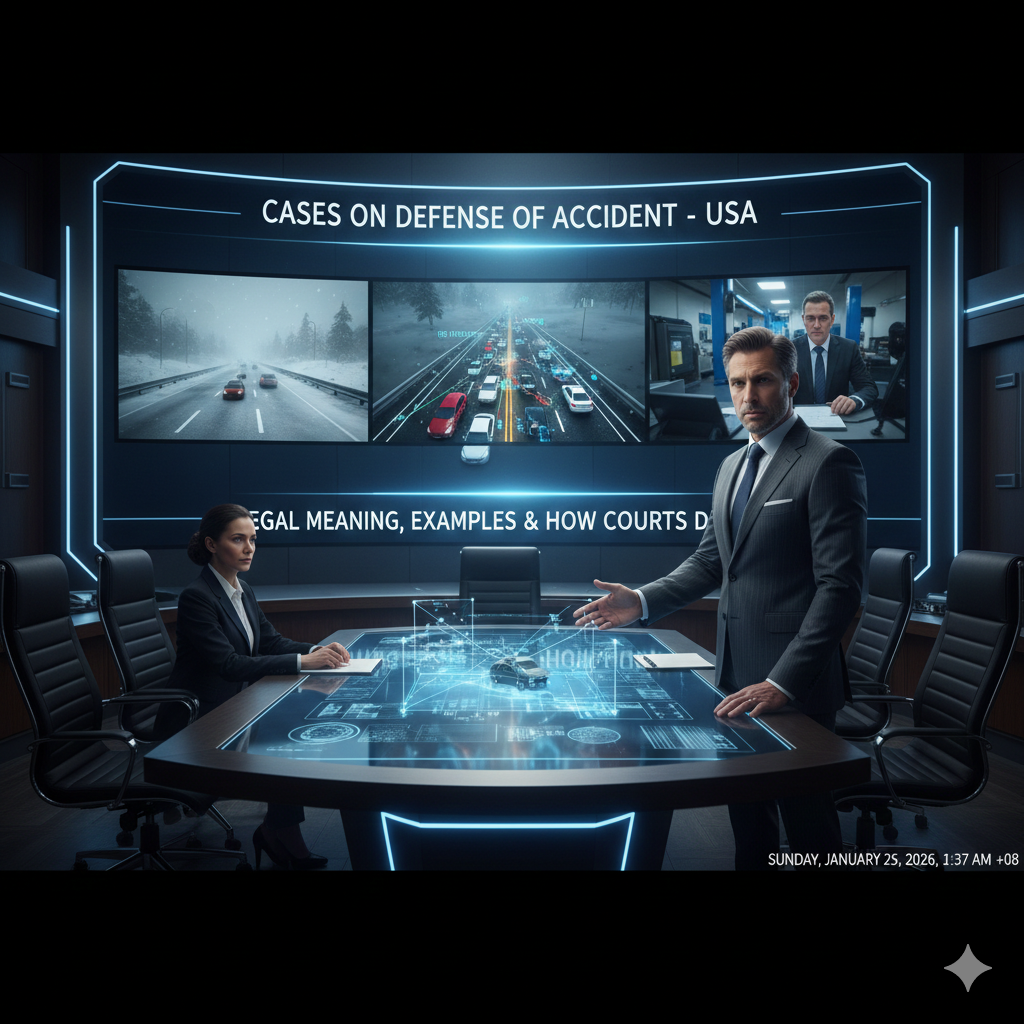
How Lawyers Prove the Defense of Accident in Court
Defense attorneys use both legal and scientific evidence to show that a harmful event was accidental rather than negligent or intentional.
Evidence Used
Lawyers rely on:
- Expert testimony (engineers, doctors, accident specialists)
- Mechanical inspections
- Medical records
- Scene analysis
For example, accident reconstruction experts can demonstrate that a crash was caused by brake failure or weather rather than reckless driving (National Institute of Justice).
Burden of Proof
In criminal trials, the prosecutors need to demonstrate intent or recklessness beyond a reasonable doubt (In re Winship, 397 U.S.358). It is not hard as the defense has to demonstrate that the incident could have been an accident and therefore it was reasonable. In the event of a doubt, then the accused should be acquitted. (In re Winship, 397 U.S. 358).
Why the Defense of Accident Fails in Some Cases
The defense of accident does not apply when a person’s own dangerous or unlawful behavior caused the harm. U.S. courts hold people accountable when they create foreseeable risks, even if they did not intend to injure anyone.
For example, intoxication eliminates the accident defense because driving under the influence is inherently reckless.
Similarly, speeding or aggressive driving removes the protection of accidents because these behaviors increase the likelihood of harm (AAA Foundation).
🔗 https://aaafoundation.org/
The defense also fails when a person ignores warnings or continues dangerous conduct despite knowing the risks. Under U.S. negligence law, prior knowledge of danger creates a duty to act (Restatement (Second) of Torts §289).
In such cases, the law treats the event as negligence not an unavoidable accident.
Why Accident Defense is Important to Injured People and Defendants
It is important to understand the defense of accidents as it has a direct impact on the legal rights and economic consequences. In personal injury litigations, accident or negligence is what defines the person to cover medical expenses, wages, and pain and suffering.
Insurance companies also rely heavily on accident defense principles. If an insurer proves that an event was unavoidable, it may deny liability coverage or reduce payouts (Insurance Information Institute).
🔗 https://www.iii.org/
For defendants, accident classification can mean the difference between freedom and criminal conviction. In criminal cases, proving the event was accidental eliminates the required intent element (mens rea), preventing punishment under U.S. law (Cornell Law School).
Even settlement values change dramatically depending on whether fault can be legally established.
Read This “Truck Accident Attorney“ post ( “A top-tier truck accident attorney knows exactly how to dismantle the Sudden Medical Emergency defense using medical records.”)
FAQs
- Is an accident a defense to law?
Yes. The U.S. law does not hold a person criminally or civilly responsible in case harm is caused without intention, recklessness, and negligence.
- Will I be able to escape criminal charges in case it was an accident?
Yes. The criminal prosecution needs to demonstrate intent or negligence. When the prosecution is unable to demonstrate the state of mind, the defendant should be acquitted (In re Winship, 397 U.S.358).
- Is it possible to be sued due to an accident?
Yes, but when negligence can be proven. In case the event is really inevitable, liability should not be considered.
- What proof is needed?
Police reports, expert testimony, mechanical inspections, medical records and witness statements are used as evidence in courts.
Note: The content published on this blog is intended solely for informational and guidance purposes. We do not offer, promote, or provide any services through this website.




Comment on “Cases on Defense of Accident in the USA – Legal Meaning, Examples & How Courts Decide”